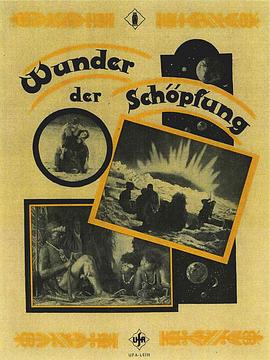
造物的奇迹
Wunder der Schöpfung is an extraordinary, fascinating Kulturfilm trying to explain the whole human knowledge of the 1920s about the world and the universe. 15 special effects experts and 9 cameramen were involved in the production of this film which combines documentary scenes, historical documents, fiction elements, animation scenes and educational impact. It its beautifully colored, using tinting and toning in a very elaborated way. Some visual ideas in the sequences with a space shuttle visiting different planets in the universe seem to have to be the inspiration for Stanley Kubrick's 2001 A Space Odyssey. In the context of Germany's Kulturfilm phenomenon, Wunder der Schöpfung was among the greatest achievements of the 1920s. The production was constructed, rehearsed, and shot over a period of two and a half years, under the supervision of Hanns Walter Kornblum. The idea to describe the universe and man's place in it well suited UFA's Grossfilm mentality, one year before the Metropolis catastrophe. Hundreds of skilled craftsmen participated in the project, building props and constructing scale models drawn by 15 special effects draughtsmen, while 9 cameramen in separate units worked on the historical, documentary, fiction, animation, and science-fiction sequences. Without star roles or even protagonists, the film's plot is crowded with meticulously structured and skillfully acted single scenes an artful mosaic of small vignettes. No less than four credited university professors ensured the factual background behind the scientific and historical events portrayed. The film's symbol of progress and the new scientific era is a spacecraft, travelling through the Milky Way, making all the planets and their inspiring worlds familiar to us, with the extravaganza of their distinctive features. The film's educational intentions, however, become steadily more obscure, humorous, or even campy as this popularization project proceeds. With the excuse of presenting the end of the world a not-so-new concept as a new, undeniably scientific truth, the film veers happily along a new path, displaying detailed apocalyptic scenes of the end of mankind. For today's audiences, this amazing film demonstrates how the universe was comprehended in the 1920s, and how that view was sold to contemporary audiences.
▶立即播放剧情简介
《造物的奇迹》讲述的是什么故事?
《造物的奇迹》Wunder der Schöpfung is an extraordinary, fascinating Kulturfilm trying to explain the whole human knowledge of the 1920s about the world and the universe. 15 special effects experts and 9 cameramen were involved in the production of this film which combines documentary scenes, historical documents, fiction elements, animation scenes and educational impact. It its beautifully colored, using tinting and toning in a very elaborated way. Some visual ideas in the sequences with a space shuttle visiting different planets in the universe seem to have to be the inspiration for Stanley Kubrick's 2001 A Space Odyssey. In the context of Germany's Kulturfilm phenomenon, Wunder der Schöpfung was among the greatest achievements of the 1920s. The production was constructed, rehearsed, and shot over a period of two and a half years, under the supervision of Hanns Walter Kornblum. The idea to describe the universe and man's place in it well suited UFA's Grossfilm mentality, one year before the Metropolis catastrophe. Hundreds of skilled craftsmen participated in the project, building props and constructing scale models drawn by 15 special effects draughtsmen, while 9 cameramen in separate units worked on the historical, documentary, fiction, animation, and science-fiction sequences. Without star roles or even protagonists, the film's plot is crowded with meticulously structured and skillfully acted single scenes an artful mosaic of small vignettes. No less than four credited university professors ensured the factual background behind the scientific and historical events portrayed. The film's symbol of progress and the new scientific era is a spacecraft, travelling through the Milky Way, making all the planets and their inspiring worlds familiar to us, with the extravaganza of their distinctive features. The film's educational intentions, however, become steadily more obscure, humorous, or even campy as this popularization project proceeds. With the excuse of presenting the end of the world a not-so-new concept as a new, undeniably scientific truth, the film veers happily along a new path, displaying detailed apocalyptic scenes of the end of mankind. For today's audiences, this amazing film demonstrates how the universe was comprehended in the 1920s, and how that view was sold to contemporary audiences.
一、《造物的奇迹》是哪一年上映的?
《造物的奇迹》是Hanns,Walter,Kornblum于1925年拍摄的一部经典科幻片。此片开创其它当代科幻片的先河,《造物的奇迹》上映时票房稳坐前三,创下当年纪录。当时Margarete,Schön,Theodor,Loos,Paul,Bildt,Margarethe,Schlegel,Oscar,Marion,Willy,Kaiser-Heyl均为最佳主角,Margarete,Schön,Theodor,Loos,Paul,Bildt,Margarethe,Schlegel,Oscar,Marion,Willy,Kaiser-Heyl以精彩演技和突出形象,奠定在其它影坛地位。Margarete,Schön,Theodor,Loos,Paul,Bildt,Margarethe,Schlegel,Oscar,Marion,Willy,Kaiser-Heyl饰演角色造型多年后仍为人所模仿。Hanns,Walter,Kornblum之前曾被人怀疑其能力,而《造物的奇迹》却奠定Hanns,Walter,Kornblum科幻片风格。
二、被称为科幻片开先河之作的《造物的奇迹》,是Hanns,Walter,Kornblum最好的作品吗?
从Hanns,Walter,Kornblum斩获科幻片最佳导演,我就觉得这部《造物的奇迹》是他最好的科幻片。虽然后来还拍出了评价特别好的作品,但《造物的奇迹》依然是其代表作之一。
三、《造物的奇迹》为什么可以成为经典?
提起其它影视,人们常会说出《造物的奇迹》的名字。这部由Hanns,Walter,Kornblum导演、Margarete,Schön,Theodor,Loos,Paul,Bildt,Margarethe,Schlegel,Oscar,Marion,Willy,Kaiser-Heyl主演的作品,在当时真的是一匹黑马。凭借扎实表演与叙事节奏,《造物的奇迹》获得广泛好评,也成为许多观众的经典记忆。
四、如何评价《造物的奇迹》?
《造物的奇迹》口碑优秀,剧情紧凑,观感流畅。你可以在 狠狠影院(didaoxiang.com)获得更稳定的播放体验与更清晰的画质。
五、《造物的奇迹》主要内容
《造物的奇迹》是一部科幻片作品,由Hanns,Walter,Kornblum执导,主演:Margarete,Schön,Theodor,Loos,Paul,Bildt,Margarethe,Schlegel,Oscar,Marion,Willy,Kaiser-Heyl。Wunder der Schöpfung is an extraordinary, fascinating Kulturfilm trying to explain the whole human knowledge of the 1920s about the world and the universe. 15 special effects experts and 9 cameramen were involved in the production of this film which combines documentary scenes, historical documents, fiction elements, animation scenes and educational impact. It its beautifully colored, using tinting and toning in a very elaborated way. Some visual ideas in the sequences with a space shuttle visiting different planets in the universe seem to have to be the inspiration for Stanley Kubrick's 2001 A Space Odyssey. In the context of Germany's Kulturfilm phenomenon, Wunder der Schöpfung was among the greatest achievements of the 1920s. The production was constructed, rehearsed, and shot over a period of two and a half years, under the supervision of Hanns Walter Kornblum. The idea to describe the universe and man's place in it well suited UFA's Grossfilm mentality, one year before the Metropolis catastrophe. Hundreds of skilled craftsmen participated in the project, building props and constructing scale models drawn by 15 special effects draughtsmen, while 9 cameramen in separate units worked on the historical, documentary, fiction, animation, and science-fiction sequences. Without star roles or even protagonists, the film's plot is crowded with meticulously structured and skillfully acted single scenes an artful mosaic of small vignettes. No less than four credited university professors ensured the factual background behind the scientific and historical events portrayed. The film's symbol of progress and the new scientific era is a spacecraft, travelling through the Milky Way, making all the planets and their inspiring worlds familiar to us, with the extravaganza of their distinctive features. The film's educational intentions, however, become steadily more obscure, humorous, or even campy as this popularization project proceeds. With the excuse of presenting the end of the world a not-so-new concept as a new, undeniably scientific truth, the film veers happily along a new path, displaying detailed apocalyptic scenes of the end of mankind. For today's audiences, this amazing film demonstrates how the universe was comprehended in the 1920s, and how that view was sold to contemporary audiences.